
TheGreenRockatKharmang:Serpentine,Jade,andaMineralMarsRoversLookFor
Serpentine turns up across both of our Kharmang licences, Hilal Abad and Mahdi Abad, alongside nephrite jade. It forms through a reaction that makes hydrogen out of rock and water, which is why NASA instruments have spent years hunting for it on Mars.
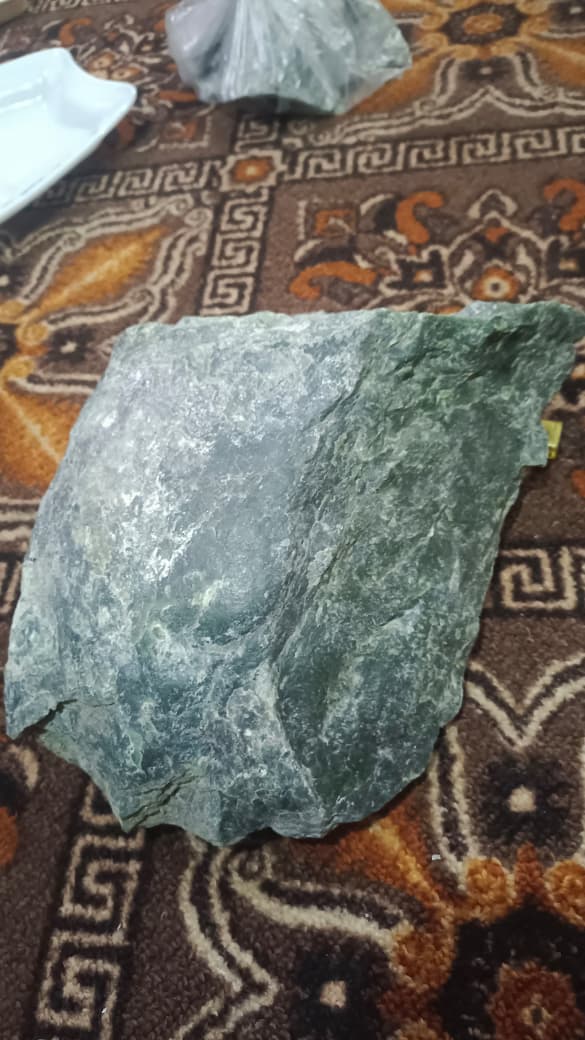
Our field teams keep coming back from Kharmang with the same rock in their hands. It is green, sometimes waxy, sometimes fibrous, and it turns up across both of our licences there: Hilal Abad and Mahdi Abad. The rock is serpentine, and its story runs a long way past the valley it came from.
Serpentine is less a single mineral than a family of them, and the way it forms is the interesting part. Deep rock rich in olivine and pyroxene meets water. The water does not simply wet the rock, it reacts with it, restructuring those minerals into something new and releasing hydrogen as it goes. Geologists call the process serpentinization. It is one of the few natural reactions that manufactures hydrogen from nothing more than rock and water.
That detail is why serpentine has an audience well outside mining. Hydrogen can feed certain kinds of microbial life. So when scientists look for places where life could plausibly have started, serpentine is one of the things they look for.
They have been looking on Mars. Researchers mapping magnesium-rich serpentine across the planet using data from the Compact Reconnaissance Imaging Spectrometer for Mars, the orbital instrument known as CRISM, identified it across 43 separate images in work published in Geophysical Research Letters in 2025. Those deposits sit in Noachian and Hesperian terrain, which is to say the oldest rock Mars still has, and their presence implies serpentinization was running there early in the planet's history. More recently the SuperCam instrument aboard the Perseverance rover picked out magnesium serpentine at three separate points along its traverse through Jezero crater: the Amalik outcrop, the Falcon Lake boulder field, and a spot the science team called Tablelands.
None of that makes the Kharmang rock extraordinary. It makes it familiar. The same reaction that left serpentine in a Baltistan valley left it in a Martian crater, and one of the most expensive machines ever landed on another world was built in part to go and find it.
There is a second reason we pay attention when serpentine appears, and this one is commercial. Nephrite jade tends to form near serpentinite, usually along contact zones where serpentinised rock meets something else. The two travel together. So when a licence produces serpentine, jade stops being a hopeful thing to look for and becomes a reasonable one. Both Hilal Abad and Mahdi Abad have produced both.
It is difficult to hold a piece of this rock and not think about how old the transaction is. The Quran describes what the earth holds in close to those terms, as provision placed rather than luck stumbled upon. Iron is named directly: "And We sent down iron with its great might, benefits for humanity" (Al-Hadid 57:25, in the translation of Dr. Mustafa Khattab). Copper appears beside it in the account of Dhul-Qarnayn sealing a mountain pass, where the instruction is to bring blocks of iron and then molten copper to pour over them (Al-Kahf 18:96). Serpentine is named nowhere in the text, and we are not going to pretend otherwise. What is named is the principle: that metal and stone in the ground are a benefit set there on purpose, and that working them is ordinary, honourable human labour rather than a trespass. For anyone mining in a Muslim society, that is not decoration on a company page. It is the baseline the work sits on.
Which brings us to the least romantic and most important fact about these two licences. You can drive to them. Road access reads like a footnote until you cost a project without it. Helicopter-supported exploration in the Karakoram can eat a budget before a single tonne of material moves. A licence a truck can reach changes the arithmetic on sampling, on bulk testing, and eventually on shipping anything at all. Hilal Abad and Mahdi Abad both have it.
The field identification of serpentine and nephrite at both sites is our own. The laboratory work behind it, along with boundary data and the full geological reporting, goes to verified investors and buyers through the investor desk rather than onto a public page. What is public sits on the Hilal Abad concession page, the Mahdi Abad Kharmang concession page, and the nephrite jade commodity page.
Continue reading
More from the field
 Durr & Zircon Mines Consortium
What the $500 Million Pakistan-US Minerals Deal Means for Gilgit Baltistan
US Strategic Metals and Pakistan signed a framework in September 2025 covering exploration through refining. The first shipment, in October 2025, was antimony, copper concentrate and rare earths, the same commodities held under licence across our own concessions.
Read insight→ Durr & Zircon Mines Consortium
Saudi Arabia's Reko Diq Stake and What It Signals for Northern Pakistan's Copper-Gold Belt
Saudi Arabia is pursuing a 15% stake in Pakistan's Reko Diq copper-gold project, backed by a reported $540 million commitment. Our Shigar and Kharmang concessions carry the same commodity pairing, at a much earlier stage.
Read insight→ Durr & Zircon Mines Consortium
Best Investment Opportunity in Gilgit Baltistan, Pakistan: What Foreign Investors Ask Us
The questions foreign investors actually ask us about mining in Gilgit Baltistan, Pakistan, answered plainly, including the parts that should make you cautious.
Read insight→